Abstract
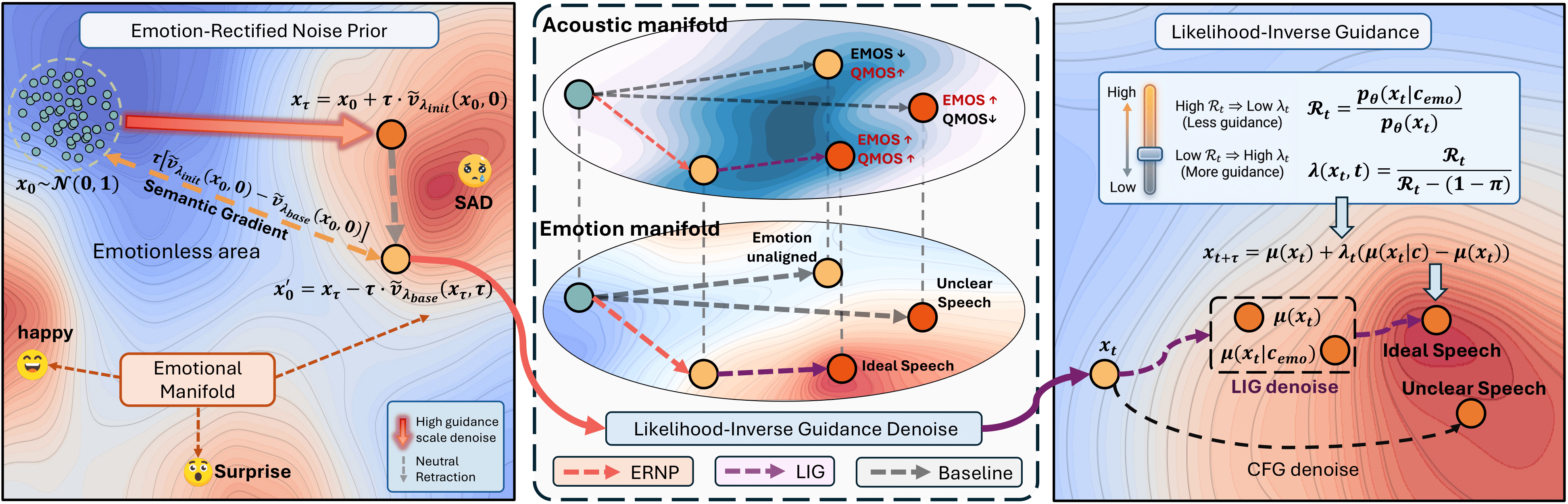
While diffusion and flow-matching models have advanced TTS, generating high-arousal emotions remains a persistent challenge due to the trade-off between stability and expressiveness. Existing systems often suffer from linguistic collapse when pursuing high intensity or fail to meet target emotional levels under stable settings. In this work, we identify that standard Gaussian initialization introduces a neutral-prosody bias, while uniform Classifier-Free Guidance can distort the acoustic manifold and lead to artifacts. To address this, we propose an inference framework that rectifies the emotional trajectory. An Emotion-Rectified Noise Prior injects a semantic gradient at initialization to align sampling with the target emotional manifold, and Likelihood-Inverse Guidance adaptively schedules guidance via a conditional/unconditional likelihood ratio, strengthening guidance only when the trajectory drifts toward a neutral fallback. Experiments show improved stability and expressiveness without retraining.